Francis Galton as Anthropologist:
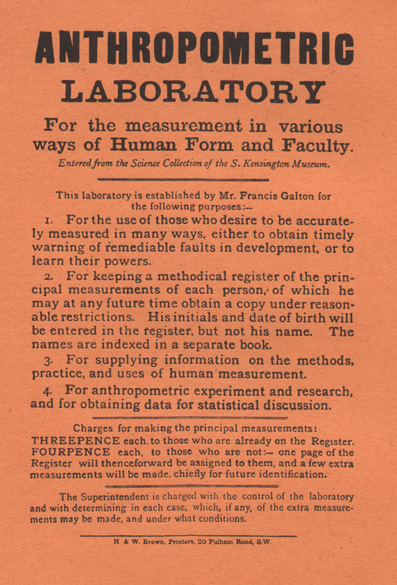
His interest in heredity led Galton to anthropometry; that is, the measurement of human characteristics. It had become clear to him that statistical investigation of data was reliable only when dealing with large sample sizes. In order to collect a sizeable amount of data he created an "Anthropometric Laboratory", which was included in the International Health Exhibition held in London in 1885. As part of this work, Galton devised the first scientific mental measurements, and thereby founded psychometrics.
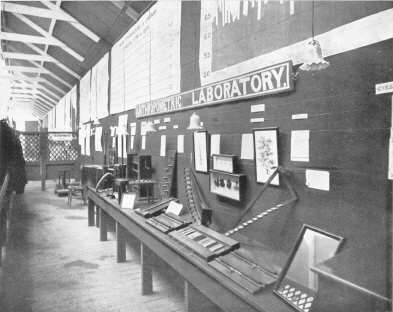
The (First) Anthropometric laboratory at the International Health Exhibition
The laboratory tested exhibit goers with instruments that Galton often had to design himself and have made to his specifications. His mechanical ingenuity quickly produced many of instruments and techniques, most of which were highly successful.
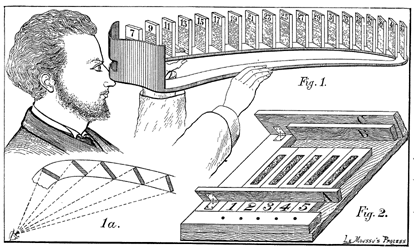
Some of Galton's instruments for measuring
vision.
Subjects were happy to pay for the privilege of being tested, in exchange for a copy of their measurements. In this way Galton was able to collect over 9000 sets of data for different individuals, obtaining a reasonably representative sample. However, Galton's collection of data was so successful that processing it all was a problem; doing so required many hours of dedicated effort, and the required techniques for analyzing it had yet to be invented. Proper treatment of a sizeable portion of this data would have to wait until the 1920s and 30s.
Following the enormous success of his exhibit, Galton established a permanent version of the laboratory at the South Kensington museum, and continued to collect data for many years. The first full analysis of this data would only take place in 1980s, when the statistical techniques and computer-based analysis were mature and fast enough to handle the task.
Franz Boas, the famous anthropologist, was aware of Galton's work, which he refers to in the following article: 'Remarks on the theory of Anthropometry' published in the Journal of the American Statistical Association, in 1893.
| Paper | 1874 | 'Proposal to apply for anthropological statistics from schools.' | Journal of the Anthropological Institute 3 : 308-11 | |
| Paper | 1875 | Notes on the Marlborough School statistics. | Journal of the Anthropological Institute 4 : 130-5 | |
| Paper | 1876 | 'On the height and weight of boys aged 14, in town and country public schools.' | Journal of the Anthropological Institute 5 : 174-80 | |
| Paper | 1877 | Anthropometry [Address to the Department of Anthropology, Section H.] | Nature 16 : 344-7 | |
| Paper | 1877 | Anthropometry [Address to the Department of Anthropology, Section H.] | Report of the British Association for the Advancement of Science : 94-100 | |
| Report | 1877 | Report of the Anthropometric Committee | Report of the British Association for the Advancement of Science 47 : 231-2 | |
| Letter | 1879 | 'The average flush of excitement.' [Letter] | Nature 20 : 121 | |
| Letter | 1880 | 'The opportunities of science masters at schools.' [Letter]. | Nature 22 (May 6) : 9-10 | |
| Paper | 1881 | Report of the Anthropometric Committee | Report of the British Association for the Advancement of Science 51 : 225-72 | |
| Paper | 1881 | 'On the application of composite portraiture to anthropological purposes.' | Report of the British Association for the Advancement of Science 51 : 3 | |
| Paper | 1882 | 'The anthropometric laboratory.' | Fortnightly Review 31 : 332-8 | |
| Paper | 1883 | 'On apparatus for testing the delicacy of the muscular and other senses in different persons.' | Journal of the Anthropological Institute 12 : 469-77 | |
| Paper | 1883 | 'Final Report of the Anthropometric Committee.' | Report of the British Association for the Advancement of Science : 253-306 | |
| Letter | 1884 | 'The cost of anthropometric measurements.' [Letter] | Nature 31 : 150 | |
| Paper | 1884 | 'The weights of British noblemen during the last three generations.' | Nature 29 : 266-8 | |
| Paper | 1885 | 'On the Anthropometric Laboratory at the late International Health Exhibition.' | Journal of the Anthropological Institute 14 : 205-18 | |
| Paper | 1885 | 'Some results of the Anthropometric Laboratory.' | Journal of the Anthropological Institute 14 : 275-87 | |
| Paper | 1885 | 'The measure of fidget.' | Nature 32 (June 25) : 174-5 | |
| Paper | 1886 | Opening remarks by the President and discussion on 'Experiments in testing the character of school children,' Sophie Bryant | Journal of the Anthropological Institute 15 : 336-8, 350 | |
| Paper | 1887 | 'On recent designs for anthropometric instruments.' | Journal of the Anthropological Institute 16 : 2-8 | |
| Interview | 1888 | [Interview with Francis Galton on Anthropometric Laboratory] | Pall Mall Gazette (November 16) : 1-2 | |
| Paper | 1888 | 'On head growth in students at the University of Cambridge.' | Nature 38 : 14-5 | |
| Paper | 1889 | Human Variety [Address delivered at the annual meeting of the Anthropological Institute of Great Britain and Ireland] | Journal of the Anthropological Institute 18 : 401-19 | |
| Paper | 1889 | 'Anthropometric Statistics from Amherst College, Mass. U.S.A.' | Journal of the Anthropological Institute 18 : 192-9 | |
| Paper | 1889 | 'On head growth in students at the University of Cambridge.' | Journal of the Anthropological Institute 18 : 155-6 | |
| Letter | 1889 | 'Head measures at Cambridge.' [Letter] | Nature 40 : 643 | |
| Paper | 1889 | 'On the principle and methods of assigning marks for bodily efficiency.' | Nature 40 : 631-2 | |
| Letter | 1889 | 'Head growth in students at the University of Cambridge.' [Letter] | Nature 40 : 318 | |
| Paper | 1889 | 'On the advisability of assigning marks for bodily efficiency in the examination of candidates for public services.' | Report of the British Association for the Advancement of Science 59 : 471-3 | |
| Paper | 1889 | 'On the principle and methods of assigning marks for bodily efficiency.' | Report of the British Association for the Advancement of Science 59 : 474-8 | |
| Paper | 1890 | Physical tests in competitive examinations. | Journal of the Society of Arts 39 : 19-27 | |
| Paper | 1890 | 'Why do we measure mankind?' | Lippincott's Monthly Magazine 45 : 236-41 | |
| Paper | 1890 | 'Cambridge anthropometry.' | Nature 41 : 454 | |
| Paper | 1890 | 'A new instrument for measuring the rate of movement of the various limbs.' (summary) | Nature 42 : 143 | |
| Paper | 1891 | 'A new instrument for measuring the rate of movement of the various limbs.' | Journal of the Anthropological Institute 20 : 200-4 | |
| Paper | 1892 | International Anthropometry. | Bulletin De L'Institut International De Statistique 6 : 10-2 | |
| Paper | 1892 | 'Retrospect of work done at my anthropometric laboratory at South Kensington.' | Journal of the Anthropological Institute 21 : 32-5 | |
| Paper | 1892 | 'Boston School Boys' | Science 20 (510, November 11) : 274-5 | |
| Paper | 1893 | 'Optical continuity.' | Nature 47 : 342-5 | |
| Report | 1893 | Mr. F. Galton on "The Just-Perceptible Difference". | Times, The (January 30) : 14b | |
| Paper | 1894 | The relative sensitivity of men and women at the nape of the neck, by Weber's test | Nature 50 : 40-2 | |
| Paper | 1894 | L'Audition coloree et les phenomenes similaires | Ztschr. Ohrenheilk 25 : 342-3 | |
| Paper | 1906 | Measurement of Resemblance | Scientific American Supplement 62 (December 22) : 25898 |
Galton's other anthropological writings ranged from race to demography; they reflect his long running involvement with the Royal Anthropological Institute, and his determined efforts to ground the discipline in the gathering and analysis of hard data.
| Report | 1863 | [Remarks on Race] | Reader, The 2 : 324 | |
| Paper | 1875 | 'On the excess of females in the West Indian Islands, from documents communicated to the Anthropological Institute of the Colonial Office.' | Journal of the Anthropological Institute 4 : 136-7 | |
| Paper | 1876 | [Discussion of 'Ultra-Centenarian Longevity', G. D. Gibb] | Journal of the Anthropological Institute 5 : 98-9 | |
| Paper | 1880 | Report of the Anthropological Committee. [contributor] | Report of the British Association for the Advancement of Science 50 : 120-159 | |
| Paper | 1882 | [Discussion on 'On the laws affecting the relations between civilized and savage life as bearing on the dealings of colonists with aborigines', H. Bartle Frere] | Journal of the Anthropological Institute 11 : 352-3 | |
| Paper | 1883 | Medical Family Registers | Fortnightly Review 34 (August) : 244-50 | |
| Paper | 1884 | [Discussion on 'On the races of the Congo and the Portuguese colonies in Western Africa', H. H. Johnston] | Journal of the Anthropological Institute 13 : 478-9 | |
| Letter | 1884 | Mr. Francis Galton's Proposed 'Family Registers' | Science (January 4) : 3 | |
| Letter | 1884 | Prize Family Records. | Times, The (June 27) : 12a | |
| Letter | 1884 | Prize Records of Family Faculties. | Times, The (May 19) : 9e | |
| Paper | 1885 | Types and their Inheritance [Presidential address, Section H, Anthropology] | Nature 32 : 507-10 | |
| Paper | 1887 | [Address delivered at the anniversary meeting of the Anthropological Institute of Great Britain and Ireland] | Journal of the Anthropological Institute 16 : 387-402 | |
| Paper | 1887 | [Opening remarks by the President] | Journal of the Anthropological Institute 16 : 175-7 | |
| Paper | 1887 | Opening Remarks on 'The native Races of America (West India)' | Journal of the Anthropological Institute 16 : 189-90 | |
| Paper | 1887 | North American pictographs. | Nature 36 : 155-7 | |
| Paper | 1888 | [Address delivered at the anniversary meeting of the Anthropological Institute of Great Britain and Ireland] | Journal of the Anthropological Institute 17 : 346-54 | |
| Paper | 1888 | [Discussion on 'On an Ancient British Settlement excavated near Rushmore, Salisbury', Pitt Rivers] | Journal of the Anthropological Institute 17 : 199-200 | |
| Paper | 1889 | [Remarks on the 'Exhibition of an ancient Peruvian gold breastplate'] | Journal of the Anthropological Institute 18 : 274 | |
| Paper | 1889 | On the principle and methods of assigning marks for bodily efficiency. (part 2) | Nature 40 : 649-52 | |
| Paper | 1892 | [Presidential address to the Division of Demography] | Transactions of the Seventh International Congress of Hygiene and Demography 10 : 7-12 |