Match: All Any Format: Sort by: Score Time Title Reverse Score Reverse Time Reverse Title
First Edition of 1853 London, John Murray
PDF Facsimile (~25 Mb) by http://galton.org With all the colour plates and maps. This is the definitive first edition, and the best to read. Also available in the full-text German translation as Bericht Eine Forschers in Tropischen Sudafrika. This version did not have the colour plates.
PDF Facsimile (~25 Mb) by http://galton.org
With all the colour plates and maps. This is the definitive first edition, and the best to read.
Also available in the full-text German translation as Bericht Eine Forschers in Tropischen Sudafrika. This version did not have the colour plates.
Second edition of 1889 Minerva Library of Famous Books
For the second edition the type was reset, with some errors creeping in, and the colour plates and map were discarded for inferior versions. Some material was discarded and new material was also appended by Galton to cover some subsequent events in the region. PDF Facsimile (~11Mb) by http://galton.org [Browse page images]
For the second edition the type was reset, with some errors creeping in, and the colour plates and map were discarded for inferior versions. Some material was discarded and new material was also appended by Galton to cover some subsequent events in the region.
PDF Facsimile (~11Mb) by http://galton.org
[Browse page images]
This is Galton's account of his expedition in the early 1850s to then relatively uncharted South-West Africa, which won him a Gold Medal from the Royal Geographical Society and launched his scientific career. It remains extremely interesting today, written in a fresh and engaging style, with keen observation of the peoples he encountered, and some fine humour.
Galton financed the expedition himself, and no members of his party came to any harm in its course of two years. Originally he had intended to reach Lake Ngami (recently discovered in Bechuanaland by Livingstone) from the Cape, but reports of hostile Boer settlers forced him to change his plans; instead he landed at Walfisch (Walvis) Bay and journeyed through the interior of what later became South-West Africa, and then Namibia, to Ovamboland and back.
This was Galton's first major work, aside from his pamphlet on the Telotype, and was widely-read and respected for its accuracy. It went through several printings and two editions. The second edition was issued in 1889 as part of the Minerva Library of Famous Books, with a new appendix covering more recent knowledge of the territory. This is the edition provided here. (This refers to itself as the "Fourth Edition" but it is taking the liberty of referring to reprints as editions).
THE following pages contain the description of a part of Africa hitherto unknown to Europeans, but which has recently been travelled over and explored by the Author. His journey was a tedious and a very anxious one, but happily brought to a close without loss of life or serious accident to any member of his large party, which altogether amounted to nearly forty men. The result of this excursion has been to fill up that blank in our maps which, lying between the Cape Colony and the western Portuguese settlements extends to the interior as far as the newly discovered Lake 'Ngami. The country of the Damaras‑warlike, pastoral Blacks, was in the first instance explored ; beyond them he found a broad tract, inhabited by aboriginal Hottentots ; and, again, to the north of these, the Ovampo, a race of intelligent and kindly negroes, who are careful agriculturists, and live in a land of great fertility. On his return southwards a quick journey was made into the interior, near the line of the southern tropic, until a road, which had recently been travelled from the borders of the Cape Colony to Lake 'Ngami, was reached, and in this way a practicable route between the Lake and the Atlantic was proved to exist. Few new objects of natural history were either collected or heard of, as the tract in question was for the most part a high barren plateau, that supported but little variety of either animal or vegetable life. The journey may perhaps produce a useful result, by indicating a very favourable opening to rnissionary enterprise, namely, among the Ovampo. The writer has no wish to commit himself to extreme views either on this or on kindred subjects, but, if philanthropists continue anxious to promote African civilisation, the remarkable advantages of Ovampoland, as a leverage ground in these matters, should not be lost sight of. The healthiness of the climate, the position of the country, the intelligence and orderly habits of the natives, their travelling and trading propensities, and, lastly, the ready access which it admits of from a healthy sea coast, form most cogent recommendation. In addition to these, though bordering on slave producing countries, Ovampoland is itself exempt from the scourge, and there would be one prejudice the less for Christian teachings to encounter.
A traveller who, starting with the same views that the Author did, chose to start from Little Fish Bay, or elsewhere, in Benguela, and explore to the eastwards and southwards, would be likely to make a very successful journey. He would find shooting in abundance, and have opportunities of learning everything about as highly interesting a race of negroes as is probably to be found in the whole of Africa. The Author's fate certainly led him over a great deal of barren country, and many monotonous days were passed ; still lie cannot regret that he undertook the journey, for, besides the enjoyment of robust health in Africa, habits of self reliance in rude emergencies were acquired, which are well worth possessing, though an English education hardly tends to promote them.
A question is commonly put to explorers, "Why could you not go further when you had already succeeded in going so far?" and the answer to this is, that several independent circumstances concur in stopping a man after he has been travelling for a certain time and distance. He must refit, for his cattle become worn out; his articles of exchange, which are his money, expended; and, indeed, the medium of currency among the people he at last reaches being unknown to him, has of course been unprovided for. His clothes, necessaries, luxuries, all become exhausted, and the capital out of which he has to support himself fast disappears. On the other hand, infinite difficulty is found in acquiring the confidence of a strange nation ; a new language has to be learnt; native servants refuse, and are unfitted to accompany their master in countries strange and probably hostile to them, and whom months of joint labours had educated into a kind of sympathy with his cause; and so, when an explorer intends to cross the frontier of a neighbouring tribe, he finds that all his old travelling arrangements are more or less broken up, and that the further progress of the expedition will require nearly as many preparations and as much delay as if it were then about quitting the borders of civilisation.
But his energies are reduced, and his means become inadequate to the task, and therefore no alternative is left him but to return while it is still possible for him to do so. It is therefore not to be expected that any large part of the vast unexplored region before us will yield its secrets to a single traveller, but, rather, that they will become known step by step through various successive discoveries; and as the experience of nearly a century corroborates these views, it is probable that for years to come there will still remain ample room in Africa for men inclined for adventure to carry out in them, if nowhere else, the metier of explorers.
8, St James's Place April 27th, 1853
FRANCIS GALTON.
News of the World, London, Feb. 2, 1851
Camp in Ovamboland
A rock in South-West Africa where Galton marked his name. Taken in the early 1900s.
Galton's name is clearly visible.
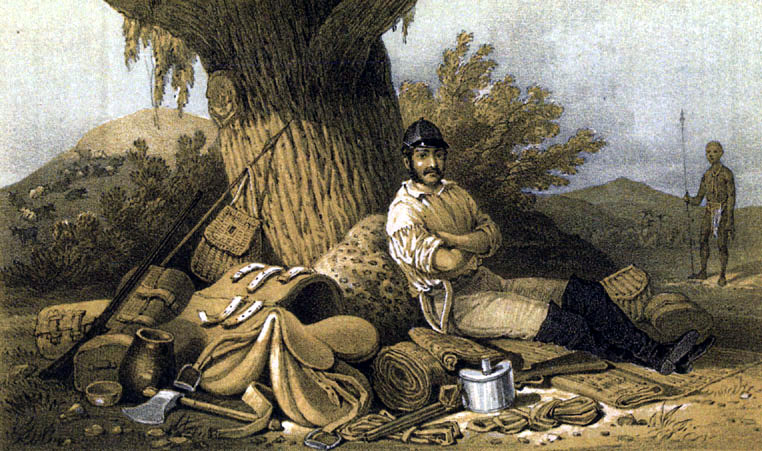
An illustrator's impression of African travel.