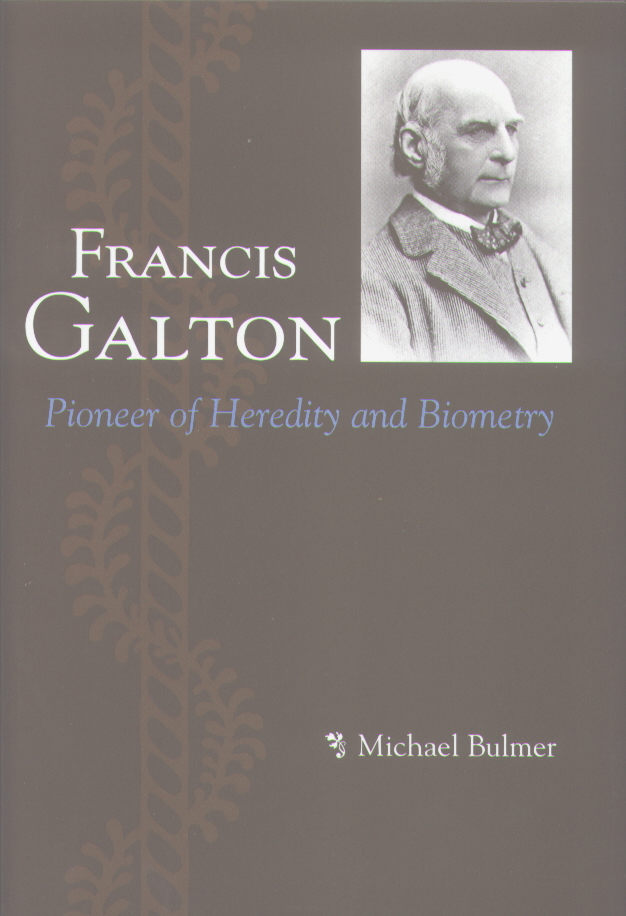
 Francis
Galton
Francis
Galton
Pioneer of Heredity and Biometry
Michael Bulmer
Johns Hopkins University Press
hardcover 0-8018-7403-3
2003 376 pp. 3 halftones and 17 line drawings
This is available through Amazon. Bulmer provides a crisp overview of Galton's life and general interests, followed by a detailed examination of Galton's general account of heredity and his statistical study of the inheritance of complex traits. HIGHLY RECOMMENDED. A detailed review will follow here.
From the
St. John Hopkins University Press description:
If not for the work of his half cousin Francis Galton, Charles Darwin's evolutionary theory might have met a somewhat different fate. In particular, with no direct evidence of natural selection and no convincing theory of heredity to explain it, Darwin needed a mathematical explanation of variability and heredity. Galton's work in biometry—the application of statistical methods to the biological sciences—laid the foundations for precisely that. This book offers readers a compelling portrait of Galton as the "father of biometry," tracing the development of his ideas and his accomplishments, and placing them in their scientific context.
Though Michael Bulmer introduces readers to the curious facts of Galton's life—as an explorer, as a polymath and member of the Victorian intellectual aristocracy, and as a proponent of eugenics—his chief concern is with Galton's pioneering studies of heredity, in the course of which he invented the statistical tools of regression and correlation. Bulmer describes Galton's early ambitions and experiments—his investigations of problems of evolutionary importance (such as the evolution of gregariousness and the function of sex), and his movement from the development of a physiological theory to a purely statistical theory of heredity, based on the properties of the normal distribution. This work, culminating in the law of ancestral heredity, also put Galton at the heart of the bitter conflict between the "ancestrians" and the "Mendelians" after the rediscovery of Mendelism in 1900. A graceful writer and an expert biometrician, Bulmer details the eventual triumph of biometrical methods in the history of quantitative genetics based on Mendelian principles, which underpins our understanding of evolution today. "Well-written, with a good pace, clear explanations, and a good eye for alternating the technical exposition with interesting personal detail. Anyone with a basic interest in the history of biology or of statistics will find it a valuable and enjoyable read."—James Franklin, University of New South Wales, author of The Science of Conjecture
"Sir Francis Galton is a neglected scientific genius. Buried under the ignominy of having coined the word eugenics only his reputation as a dilettante amateur scientist survived. But in this book, Michael Bulmer shows that Galton was to the science of heredity what Charles Babbage was to computing. Babbage knew no electrons and Galton no genes, but their ideas have transcended the discovery of both. Bulmer gives the first full account of Galton's theory of ancestral heredity which so influenced Pearson, and shows how, with his experiments on the inheritance of seed-weight in the sweet pea, Galton did for the inheritance of continuous characters what Gregor Mendel (unknown to Galton and his generation) had done for discrete characters. Bulmer's book is a major contribution to an understanding of the path-breaking biological and statistical work of 'the father of biometry'."—A. W. F. Edwards, University of Cambridge, author of Pascal's Arithmetic Triangle and Likelihood
Michael Bulmer is Emeritus Fellow of Wolfson College, Oxford University.