OCR Rendition - approximate288 Mr. Francis Galton [Feb. 9,
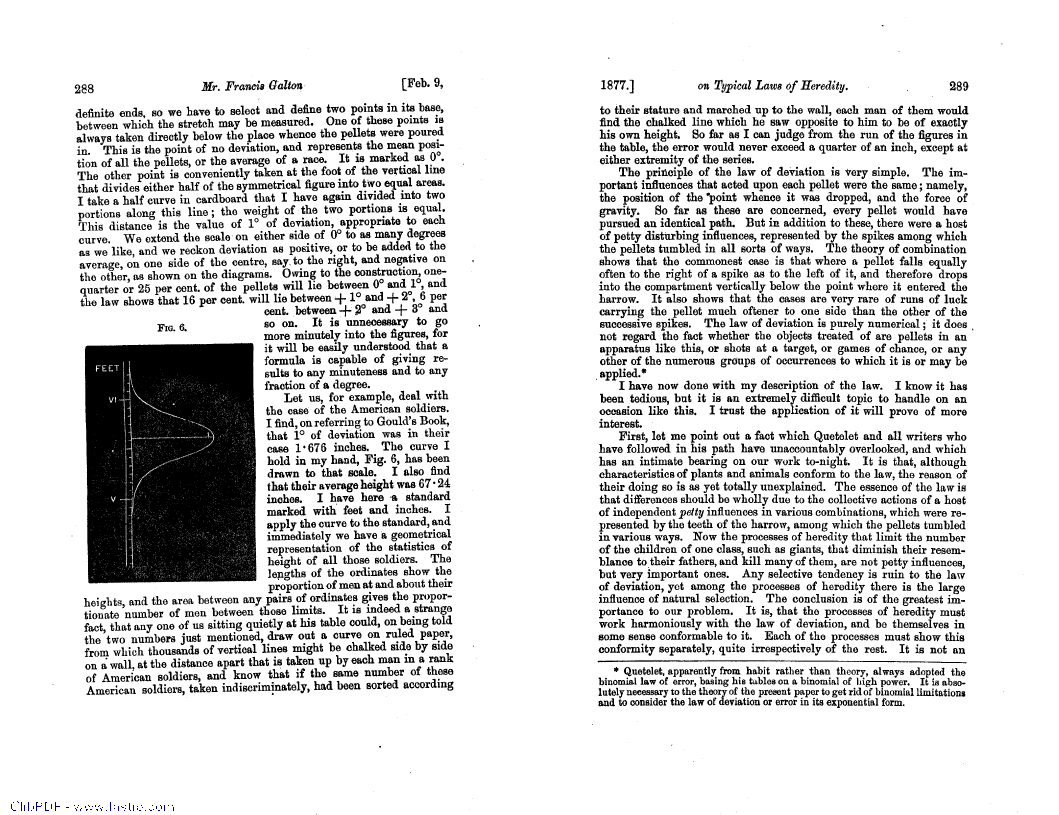
definite ends, so we have to select and define two points in its base, between which the stretch may be measured. One of these points is always taken directly below the place whence the pellets were poured in. This is the point of no deviation, and represents the mean position of all the pellets, or the average of a race. It is marked as 0°. The other point is conveniently taken at the foot of the vertical line that divides either half of the symmetrical figure into two equal areas. I take a half curve in cardboard that I have again divided into two portions along this line ; the weight of the two portions is equal. This distance is the value of 1° of deviation, appropriate to each curve. We extend the scale on either side of 0° to as many degrees as we like, and we reckon deviation as positive, or to be added to the average, on one side of the centre, say, to the right, and negative on the other, as shown on the diagrams. Owing to the construction, onequarter or 25 per cent. of the pellets will lie between 0° and 1°, and the law shows that 16 per cent. will lie between ± 1° and + 2°, 6 per
cent. between + 2° and + 3° and so on. It is unnecessary to go more minutely into the figures, for it will be easily understood that a formula is capable of giving results to any minuteness and to any fraction of a degree.
Let us, for example, deal with
the case of the American soldiers.
I find, on referring to Gould's Book,
that 1° of deviation was in their
case 1.676 inches. The curve I
hold in my hand, Fig. 6, has been
drawn to that scale. I also find
that their average height was 67.24
inches. I have here -a standard
marked with feet and inches. I
apply the curve to the standard, and
immediately we have a geometrical
representation of the statistics of
height of all those soldiers. The
lengths of the ordinates show the
proportion of men at and about their
heights, and the area between any pairs of ordinates gives the propor
tionate number of men between those limits. It is indeed a strange
fact, that any one of us sitting quietly at his table could, on being told
the two numbers just mentioned, draw out a curve on ruled paper,
from which thousands of vertical lines might be chalked side by side
on a wall, at the distance apart that is taken up by each man in a rank
of American soldiers, and know that if the same number of these
American soldiers, taken indiscriminately, had been sorted according
to their stature and marched up to the wall, each man of them would find the chalked line which he saw opposite to him to be of exactly his own height. So far as I can judge from the run of the figures in the table, the error would never exceed a quarter of an inch, except at either extremity of the series.
The principle of the law of deviation is very simple. The important influences that acted upon each pellet were the same ; namely, the position of the point whence it was dropped, and the force of gravity. So far as these are concerned, every pellet would have pursued an identical path. But in addition to these, there were a host of petty disturbing influences, represented by the spikes among which the pellets tumbled in all sorts of ways. The theory of combination shows that the commonest case is that where a pellet falls equally often to the right of a spike as to the left of it, and therefore drops into the compartment vertically below the point where it entered the harrow. It also shows that the cases are very rare of runs of luck carrying the pellet much oftener to one side than the other of the successive spikes. The law of deviation is purely numerical ; it does not regard the fact whether the objects treated of are pellets in an apparatus like this, or shots at a target, or games of chance, or any other of the numerous groups of occurrences to which it is or may be applied.*
I have now done with my description of the law. I know it has been tedious, but it is an extremely difficult topic to handle on an occasion like this. I trust the application of it will prove of more interest.
First, let me point out a fact which Quetelet and all writers who have followed in his path have unaccountably overlooked, and which has an intimate bearing on our work to-night. It is that, although characteristics of plants and animals conform to the law, the reason of their doing so is as yet totally unexplained. The essence of the law is that differences should be wholly due to the collective actions of a host of independent petty influences in various combinations, which were represented by the teeth of the harrow, among which the pellets tumbled in various ways. Now the processes of heredity that limit the number of the children of one class, such as giants, that diminish their resemblance to their fathers, and kill many of them, are not petty influences, but very important ones. Any selective tendency is ruin to the law of deviation, yet among the processes of heredity there is the large influence of natural selection. The conclusion is of the greatest importance to our problem. It is, that the processes of heredity must work harmoniously with the law of deviation, and be themselves in some sense conformable to it. Each of the processes must show this conformity separately, quite irrespectively of the rest. It is not an
* Quetelet, apparently from habit rather than theory, always adopted the binomial law of error, basing his tables on a binomial of high power. It is absolutely necessary to the theory of the present paper to get rid of binomial limitations and to consider the law of eviation or error in its exponential form.
1877.] on Typical Laws of Heredity.
289
Pie. 6.
CIibPDF - www.fastio.com
|