OCR Rendition - approximate286 Mr. Francis Galton [Feb. 9,
show, and what the two numbers are, which enable long series to be calculated like those in the tables just referred to. The simplest way of explaining the law is to begin by showing it in action. For this purpose I will use an apparatus that I employed three years ago in this very theatre, to illustrate other points connected with the law of deviation. An extension of its performance will prove of great service to us to-night ; but I will begin by working the instrument as I did on the previous occasion. The portion of it that then existed, and to whisk I desire now to confine your, attention, is! shown in the lower part of Fig. 1, where I wish to direct your notice to the stream issuing from either of the divisions just above the dots, to its dispersion among them, and to the little heap that it forms on the bottom line. This part of the apparatus is like a harrow with its spikes facing us ; below these are vertical compartments ; the whole is faced with a glass plate. I will pour pellets from either of these divisions or from any other point above the spikes ; they will fall against the spikes, tumble about among them, and after pursuing devious paths, each will finally sink to rest in the compartment that lies beneath the place whence it emerges from its troubles.
The courses of the pellets are extremely irregular; it rarely happens that any two starting from the same point will pursue the same path from beginning to end; yet, notwithstanding this, you will observe the regularity of the outline of the heap formed by the accumulation of pellets.
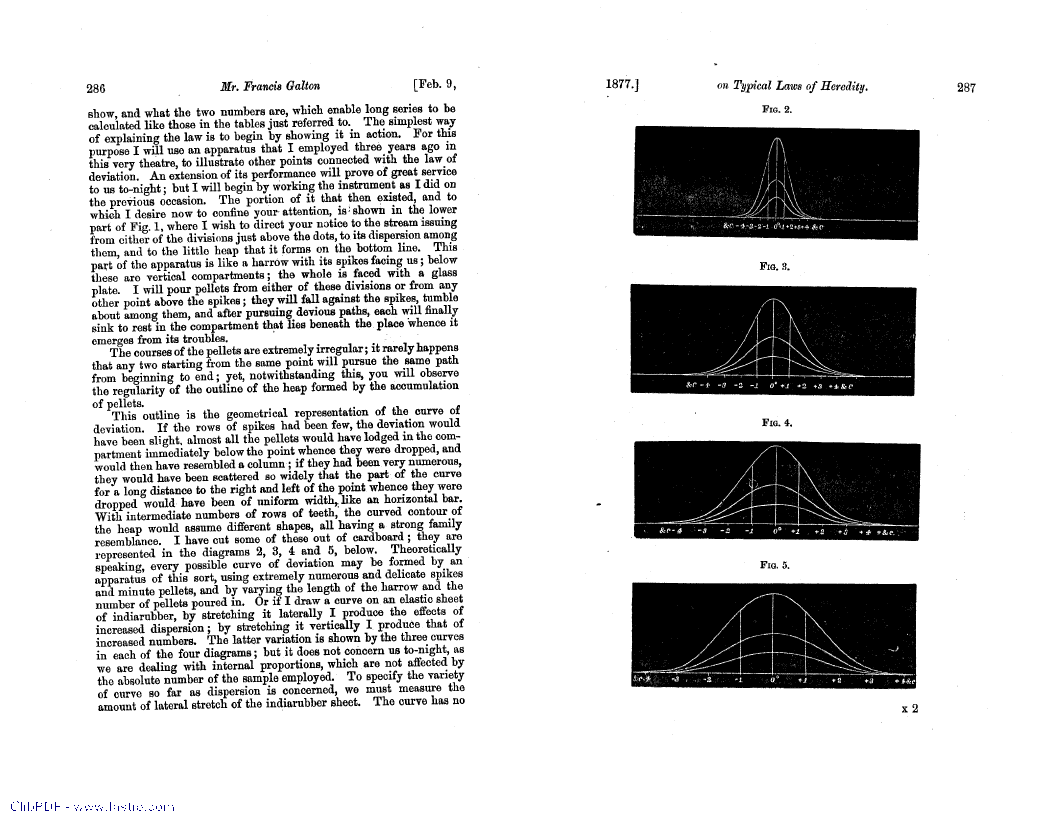
This outline is the geometrical representation of the curve of deviation. If the rows of spikes had been few, the deviation would have been slight, almost all the pellets would have lodged in the compartment immediately below the point whence they were dropped, and would then have resembled a column ; if they had been very numerous, they would have been scattered so widely that the part of the curve for a long distance to the right and left of the point whence they were dropped would have been of uniform width,, like an horizontal bar. With intermediate numbers of rows of teeth, the curved contour of the heap would assume different shapes, all having a strong family resemblance. I have cut some of these out of cardboard ; they are represented in the diagrams 2, 3, 4 and 5, below. Theoretically speaking, every possible curve of deviation may be formed by an apparatus of this sort, using extremely numerous and delicate spikes and minute pellets, and by varying the length of the barrow and the number of pellets poured in. Or if I draw a curve on an elastic sheet of indiarubber, by stretching it laterally I produce the effects of increased dispersion ; by stretching it vertically I produce that of increased numbers. The latter variation is shown by the three curves in each of the four diagrams ; but it does not concern us to-night, as we are dealing with internal proportions, which are not affected by the absolute number of the sample employed. To specify the variety of curve so far as dispersion is concerned, we must measure the amount of lateral stretch of the indiarubber sheet. The curve has no
1877.]
on Typical Laws of Heredity. Fia. 2.
287
FIG. 3.
Fla. 4.
Fin. 5.
CIibPDF - www.fastio.com
|