OCR Rendition - approximate300 Mr. Francis Gallon [Feb. 9,
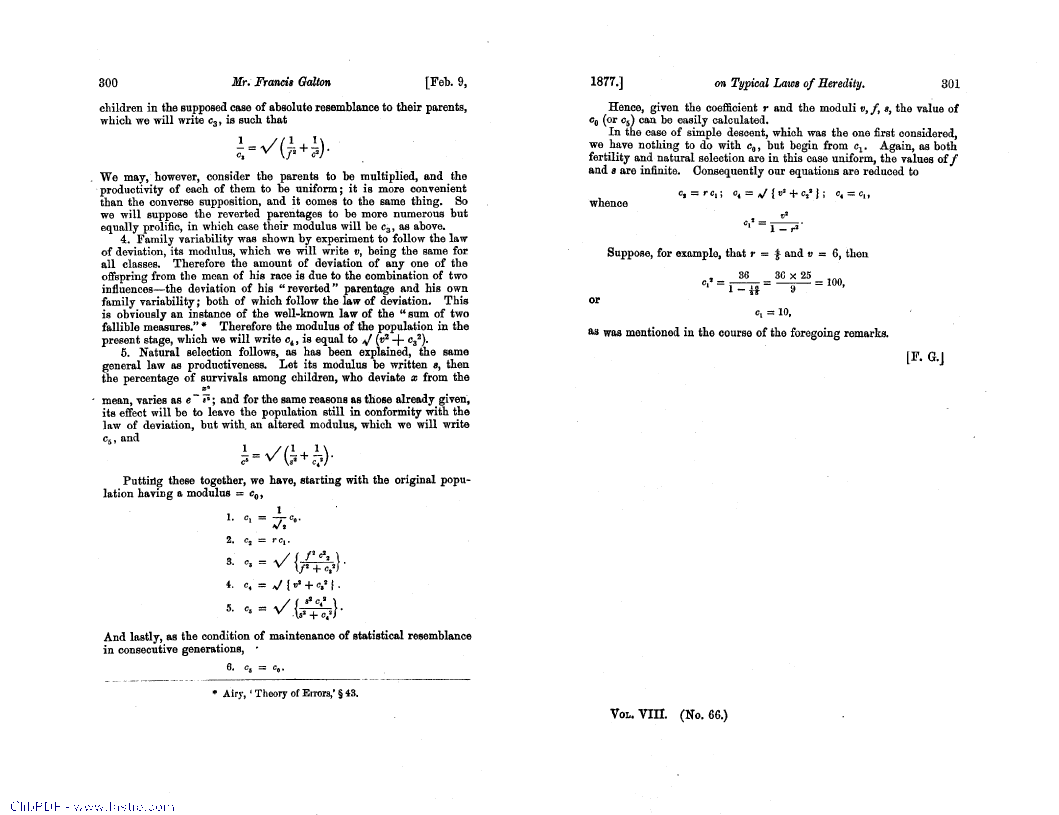
children in the supposed case of absolute resemblance to their parents, which we will write c3, is such that
s V ( I +~).
We may, however, consider the parents to be multiplied, and the productivity of each of them to be uniform; it is more convenient than the converse supposition, and it comes to the same thing. So we will suppose the reverted parentages to be more numerous but equally prolific, in which case their modulus will be c3, as above.
4. Family variability was shown by experiment to follow the law of deviation, its modulus, which we will write v, being the same for all classes. Therefore the amount of deviation of any one of the offspring from the mean of his race is due to the combination of two influences-the deviation of his "reverted" parentage and his own family variability; both of which follow the law of deviation. This is obviously an instance of the well-known law of the "sum of two fallible measures." 's Therefore the modulus of the population in the present stage, which we will write c4, is equal to ,,/ (v2 + 032).
5. Natural selection follows, as has been explained, the same general law as productiveness. Let its modulus be written 8, then the percentage of survivals among children, who deviate x from the
0s
mean, varies as e - d9 ; and for the same reasons as those already given, its effect will be to leave the population still in conformity with the law of deviation, but with, an altered modulus, which we will write
C6, and /
C = \8 +i,)
.
Putting these together, we have, starting with the original population having a modulus = co,
1. C, = CO.
Y
2. c,=rel.
~ / fa Cx
3. c, = v {fY + CYY} .
C, =.(v'+c,YE.
V YCY
ca = v {ys + ~~Y}
And lastly, as the condition of maintenance of statistical resemblance in consecutive generations,
6. C, = C'.
* Airy, ' Theory of Errors,' § 43.
1877.] on Typical Lawn of Heredity. 301
Hence, given the coefficient r and the moduli v, f, s, the value of co (or c6) can be easily calculated.
In the case of simple descent, which was the one first considered, we have nothing to do with ca, but begin from cl. Again, as both fertility and natural selection are in this case uniform, the values of f and a are infinite. Consequently our equations are reduced to
CS = r C, ; C4 = 411 v' + 022 1 ; 04 = C, I
Suppose, for example, that r = aI and v = 6, then
C12 = 36 _ 36 x 25 = 100
I -$$ 9 '
or
c,=10,
as was mentioned in the course of the foregoing remarks.
VOL. VIII. (No. 66.)
whence
C,Y =
vY
1-r'
4. 5.
[F. G.]
CIibPDF - www.fastio.com
|