OCR Rendition - approximate142 WATSON and GALTON. Extinction of Families.
multiplying that of the preceding generation, by t, + 2t$, and this quantity is in the present case equal to one.
if axes Ox and Oy be drawn, and equal distances along Ox represent generations from starting, while two distances are marked along every ordinate, the one representing the total male population in any generation, and the other the number of remaining surnames in that generation, of the two curves passing through the extremities of these ordinates, the population curve will, in this case, be a straight line parallel to Ox, while the surname curve will intersect the population curve on the axis of y, will proceed always convex to the axis of x, and will have the positive part of that axis for an asymptote.
The case just discussed illustrates the use to be made of the general formula, as well as the labour of successive substitutions, when the expressions f, (x) does not follow some assigned law. The calculation may be infinitely simplified when such a law can be found ; especially if that law be the expansion of a binomial, and only the extinctions are required.
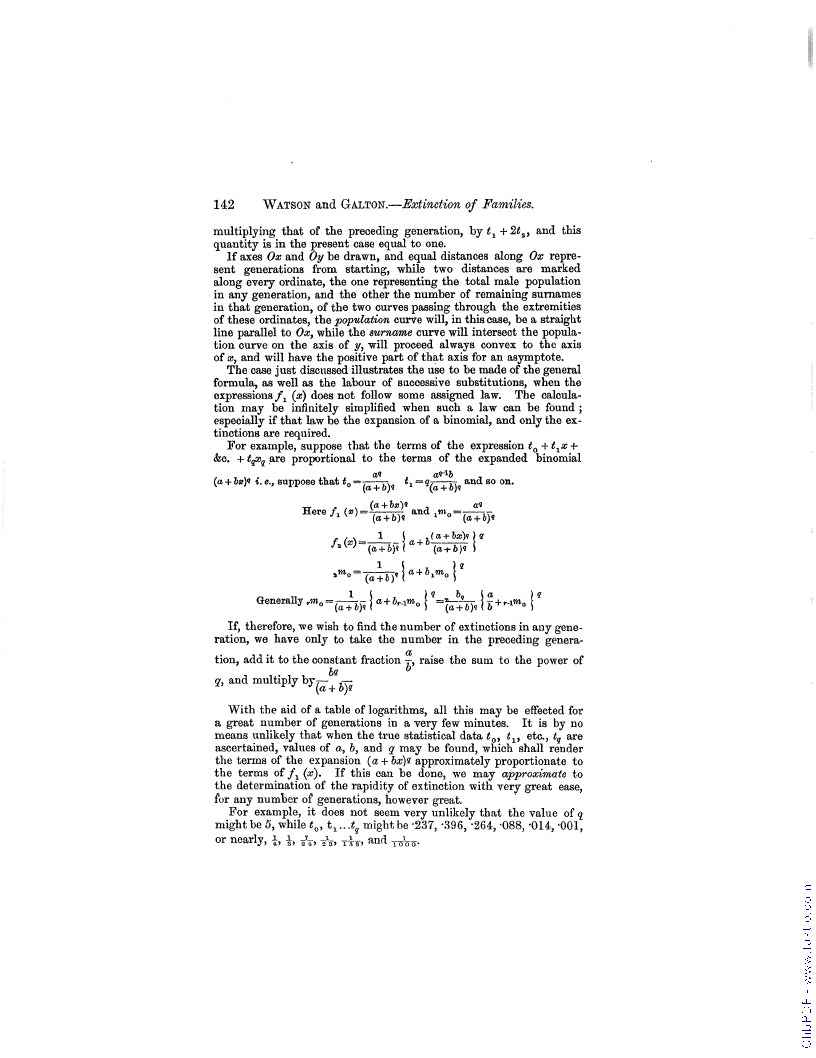
For example, suppose that the terms of the expression to + t,x + &c. + tgxq are proportional to the terms of the expanded binomial
i
(a+bx)q i.e., suppose that to=is+b)a t,=q(a+b)v and so on.
Here f, (X)=((a+b)qq and ,mo=(a+,y
f, (x)=(a+b)q I a+b-(a+b qq q
'mo (a+b)q 1 a+b,mo 4
Generally ,in.=(a+b)q € a+b,._,mo q=~ +b)4I b+,.lmo q
If, therefore, we wish to find the number of extinctions in any generation, we have only to take the number in the preceding genera
tion, add it to the constant fraction b, raise the sum to the power of q, and multiply by bq
(a-+ b)q
With the aid of a table of logarithms, all this may be effected for a great number of generations in a very few minutes. It is by no means unlikely that when the true statistical data to, t„ etc., tq are ascertained, values of a, b, and q may be found, which shall render the terms of the expansion (a + bx)q approximately proportionate to the terms of f, (x). If this can be done, we may approximate to the determination of the rapidity of extinction with very great ease, for any number of generations, however great.
For example, it does not seem very unlikely that the value of q
night be 5, while to, t, ...tg might be •237, •396, •264, •088, •014, -001, or nearly, h, s, s -E 'la, i v s, and z o 00.
|