OCR Rendition - approximateWATSON and GALTON.-Extinction of Fczzzzilies. 141
then the proportional number of groups of surnames with s representatives in the rth generation will be the coefficient of x' in f, (x) and the actual number of such surnames will be found by multiplying this coefficient by N. The number of surnames unrepresented or become extinct in the rth generation will be found by multiplying the term independent of x in f, (x) by the number N.
The determination, therefore, of the rapidity of extinction of surnames, when the statistical data, t0, t1, etc., are given, is reduced to the mechanical, but generally laborious process of successive substitution of to + tIx + t2x2 + etc., for x in successively determined values of f, (x), and no further progress can be made with the problem until these statistical data are fixed; the following illustrations of the application of our formula are, however, not without interest.
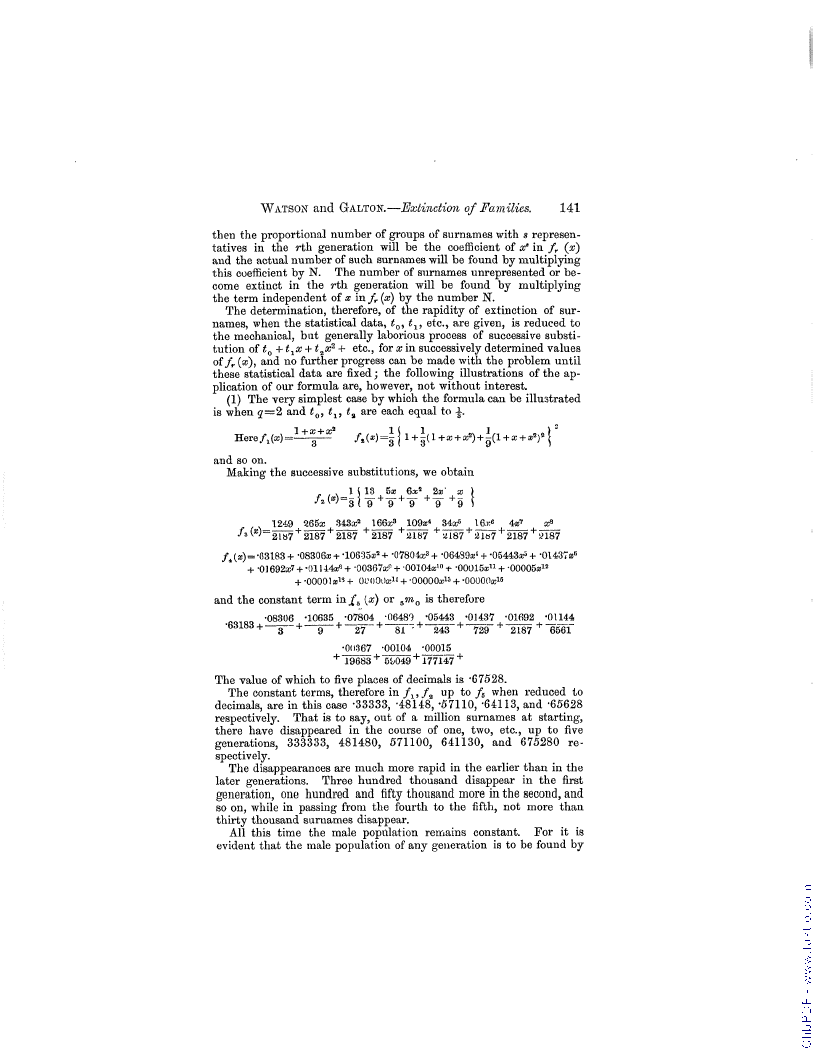
(1) The very simplest case by which the formula can be illustrated is when q=2 and t0, t7, t, are each equal to s.
a
Herefl(x)=1+3+x ~,.,(x)=3 1+,1-(l+x+xa)+9(l+x+x2)2
and so on.
Making the successive substitutions, we obtain
1113 5x 6x2 2!'+x
_
A (x) =3 9+9+9 +9 9
1249 265x 343x2 166x8 109x4 34x5 16.,:6 4x7 x8 f'(x)-21x7+2187+218 787 +2187 +2187 +2187+21x7+2187+2187
f, (x)= •03183 + •08306x + •10635x2 + •07804x3 + •06439x' + •05443x + •01437x8
+ •01692x7 + -011440 + '00367x" + '00104x" + •00015x" + •00005x12
+-00001X15+ OU OOUx71 + •OOOOOx75 + •00000x16
and the constant term in f6 (x) or mo is therefore
08306 •10635 •07804 •06489 •05443 -01437 •01692 •0114_4 63183+ 3 + 9 + 27-+ 81 -+ 243 + 729 + 2187 + 6561
00367 •00104 •00015
+ 19683 + 51,049 + 177147 +
The value of which to five places of decimals is 67528.
The constant terms, therefore in fy7 f2 up to f, when reduced to decimals, are in this case •33333, •48148, •57110, -64113, and •65628 respectively. That is to say, out of a million surnames at starting, there have disappeared in the course of one, two, etc., up to five generations, 333333, 481480, 571100, 641130, and 675280 respectively.
The disappearances are much more rapid in the earlier than in the later generations. Three hundred thousand disappear in the first generation, one hundred and fifty thousand more in the second, and so on, while in passing from the fourth to the fifth, not more than thirty thousand surnames disappear.
All this time the male population remains constant. For it is evident that the male population of any generation is to be found by
|