OCR Rendition - approximate294 Mr. Francis Galton [Feb. 9,
should be nil; that is, that there should not be the least tendency for tall men to marry tall women rather than short ones. Each strictly typical quality taken by itself must go for nothing in sexual selection. Under these circumstances, one of the best known properties of the law of deviation (technically called that of "two fallible measures ") shows that the population of sums of couples would conform truly to the law, and the value of 1° would be that of the original population multiplied by `/2. Consequently the population of means of couples would equally conform to the law; but in this case, as the deviations of means of couples are half those of sums of couples, the 1° of original deviation would have to be divided by ,~/2. .
The two remaining processes are Productiveness and Survival. Physiologically they are alike, and it is reasonable to expect the same general law to govern both. Natural selection is measured by the percentage of survival among individuals born with like characteristics. Productiveness is measured by the average number of children from all parents who have like characteristics, but it may physiologically be looked upon as the percentage of survival of a vast and unknown number of possible embryos, producible by such parents. The number being unknown creates no difficulty, if there may be considered to be, on an average, the same in every class. Experiment could tell me little about either natural selection or productiveness. What I have to say is based on plain theory. I can explain this best by the process of natural selection. In each species, the height, &c., the most favoured by natural selection, is the one in which the demerits of excess or deficiency are the most frequently balanced. It is therefore not unreasonable to look at nature as a marksman, her aim being subject to the same law of deviation as that which causes the shot on a target to be dispersed on either side of the point aimed at. It would not be difficult, but it would be tedious, to justify the analogy; however, it is unnecessary to do so, as I propose to base the analogy on the exigencies of the typical formula, no other supposition being capable of fulfilling its requirements. Suppose for a
FIG. 7.
moment hat nature aims, as a marksman, at the medium class, on purpose to destroy and not to save it. Let a block of stone, as is Fig. 7, represent a rampart, and let a gun be directed at a vertical line
1877.] on Typical Laws of Heredity. 295
on its side on purpose to breach it, the shots would fall with the greatest frequency in the neighbourhood of the vertical line, and their marks would diminish in frequency as the distance increased, in conformity with the law of deviation. Each shot would batter away a bit of stone, and the shape of the breach would be such that its horizontal outline will be the well-known curve. This would be the action of nature were she to aim at the destruction of medium sizes. Her action as preserver of them is the exact converse, and would be represented by a cast that filled the gap and exactly replaced the material that had been battered away. The percentage of thickness of wall that had been destroyed at each degree of deviation is represented by the ordinate of the curve, therefore the percentage of survival is also an ordinate of the same curve of deviation. Its scale has a special value in each instance, subject to the general condition in every typical case, that its 0° shall correspond to the 0° of deviation of height, or whatever the characteristic may be.
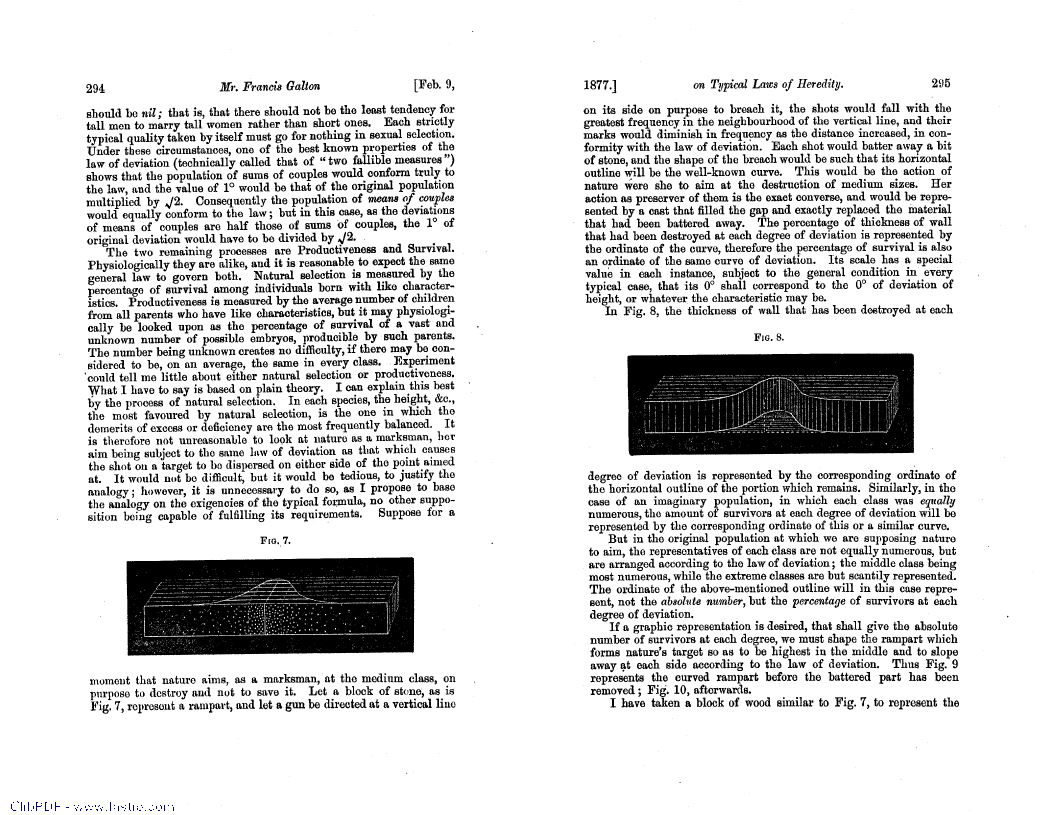
In Fig. 8, the thickness of wall that has been destroyed at each
FIG. 8.
degree of deviation is represented by the corresponding ordinate of the horizontal outline of the portion which remains. Similarly, in the case of an imaginary population, in which each class was equally numerous, the amount of survivors at each degree of deviation will be represented by the corresponding ordinate of this or a similar curve.
But in the original population at which we are supposing nature to aim, the representatives of each class are not equally numerous, but are arranged according to the law of deviation; the middle class being most numerous, while the extreme classes are but scantily represented. The ordinate of the above-mentioned outline will in this case represent, not the absolute number, but the percentage of survivors at each degree of deviation.
If a graphic representation is desired, that shall give the absolute number of survivors at each degree, we must shape the rampart which forms nature's target so as to be highest in the middle and to slope away at each side according to the law of deviation. Thus Fig. 9 represents the curved rampart before the battered part has been removed ; Fig. 10, afterwards.
I have taken a block of wood similar to Fig. 7, to represent the
CIibPDF - www.fastio.com
|