Photographic Researches and Portraiture 327
Two of these five standard points, nasion F and pogonion C, are used to get an absolute base. CF is taken vertical, treated as axis of y, and made 50 units in length, the unit being with Galton a millimetre; no fractions being given. The axis CX of x is taken perpendicular to CF, and the coordinates of N, Mi and S require two double-figure numbers each for plotting. Thus far we have reached a lexicon in which nsso-pogonial length and the coordinates of rhinion, hypercheilon and syncheilion would enable us to identify a profile-the errors of measurement being as Galton- says small as compared to the variations due to individuality.
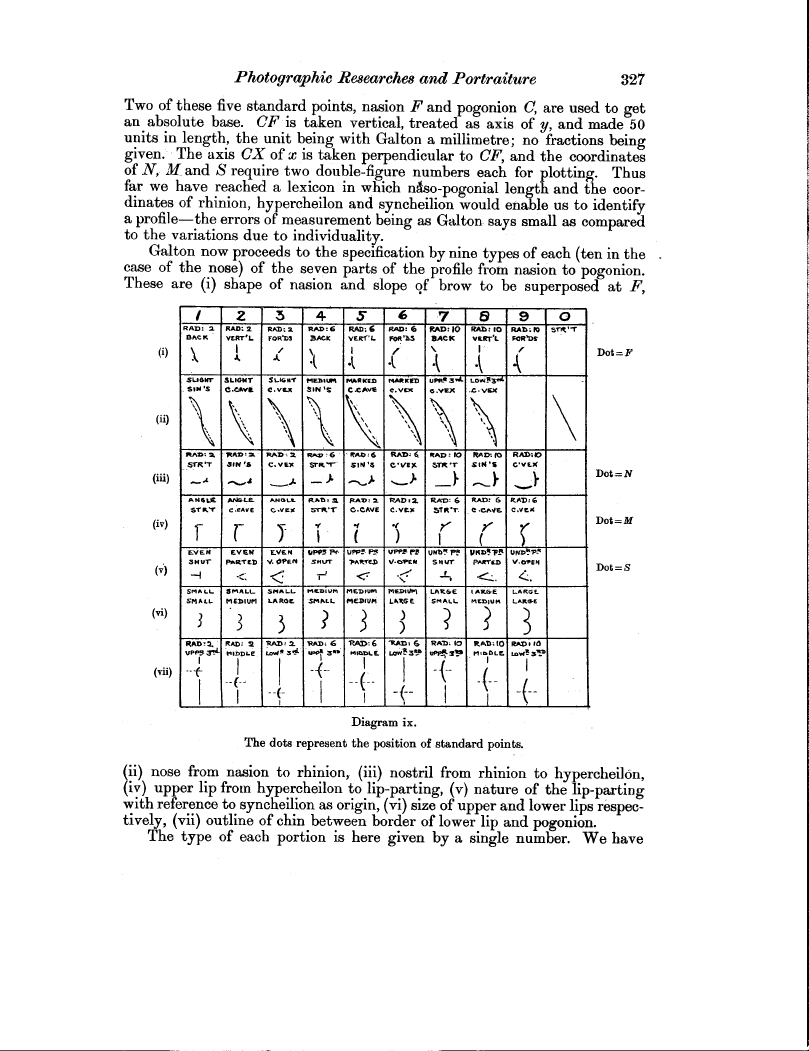
Galton now proceeds to the specification by nine types of each (ten in the case of the nose) of the seven parts of the profile from nasion to pogonion. These are (i) shape of nasion and slope of brow to be superposed at F,
(L)
| |
2 |
3 |
4 |
|
6 |
|
9 |
|
0 |
|
RAD• 1
BACK |
RAD. 2
VERT'L |
RAD:2
FOR'D3
A |
RAD:6
BACK
\~ |
PAD; 6
VER4'L
\ |
RAD: 6
FOR'33
/ |
RAD:1O
SACK |
RAD:10
VER{'L |
RADIO
WR'DS |
5TR'T |
|
SLIGHT
SIN'S |
SLIGHT
C.CAVE |
SLIGHT
C. VEX |
MEDIUM
SIN'S |
MARKED
C.CAVE
\
\ |
MARKED
C.VEX
\
~ |
UPRR31&
C.VEX
V |
LOMP3A
C. VEX |
|
|
|
RA= %
STR'T |
RAID • 1
SIN'S |
MAD • 2
C.VEX |
RAID - 6
STRIT' |
RAD: 6
SIN'S |
RAID., 6
C'VEX |
RAD : IO
5TR'T |
RAD: KI
SIN'S |
RAD7 'U
C.VEX |
|
|
ANGLE
ST RY |
ANiLE
C.CAVE |
ANGLC
-VEX |
RAOIA
STR'T |
RAID :2.
C.CAVE |
RADL2
C.VEK |
RAD:6
STR'T |
RAD: 6
C. CAVE |
RAD:6
C.VEK |
|
|
EVEN
SHUT |
EVEN
PARTED |
EVEN
V.OPEM |
IOPPS TAF
SRVT |
UPPR P3
'PARTED |
VPPS PS
V•OP[N |
UNDR PP
SHUT |
VKDI'
PARTED |
UNDAPR
V.OPEN |
|
|
SMALL
SMALL |
SMALL
MEDIUM |
SMALL
LARGE
3 |
MEDIUM
SMALL
1 |
MEDIUM
MEDIUM
3 |
MEDIUM/
LARGE
3 |
LARGE
SMALL |
LARGE
MEDIUM |
LARGE
LARN.
3 |
|
|
RAD•9.
UPPR |
|
RAD' 2
MIDDLE
E |
|
RAD°2
LOW-34 |
uTP*1 |
RAD.6
3RD |
PAD: 6
MIDDLE |
|
'RAMI6
LOWR3"_A |
RAM-10
VPPR3!b |
RADIO
MIDDLE |
RADIIO
LOWx3'! |
|
Dot=F
Dot=N
Dot=M
(v)
Dot=S
Diagram ix.
The dots represent the position of standard points.
(ii) nose from nasion to rhinion, (iii) nostril from rhinion to hypercheilon, (iv) upper lip from hypercheilon to lip-parting, (v) nature of the lip-parting with reference to syncheilion as origin, (vi) size of upper and lower lips respectively, (vii) outline of chin between border of lower lip and pogonion.
The type of each portion is here given by a single number. We have